segunda-feira, 2 de junho de 2008

How Plasma From Superstorms Affects Near-Earth Space

May 31, 2008


NASA scientists have uncovered new details about how plasma from superstorms interact with Earth’s magnetosphere.

“The surprising result of this model is that the magnetosphere’s main phase pressure is dominated by energetic protons from the plasmasphere, rather than from the solar wind,” says Mei-Ching Fok, an astrophysicist at NASA’s Goddard Space Flight Center in Greenbelt, Md. Fok and her team will present their findings on May 29 at the American Geophysical Union conference in Ft. Lauderdale, Fl.

Violent activity on the sun, such as a solar flare, can produce a monster superstorm that releases plasma into the solar wind. Large flares often result in an ejection of material from the solar corona, called a coronal mass ejection (CME). A CME can spew billions of tons of plasma away from the sun and toward Earth at speeds faster than 1.5 million mph. The plasma affects Earth and the vicinity surrounding Earth dominated by its magnetic field, called the magnetosphere.

As plasma from a superstorm interacts with Earth’s magnetosphere, it can trigger spectacular displays of the Northern Lights, called auroras, interfere with communications between satellites and airplanes traveling near the North Pole, and interrupt global positioning systems and our power grid.

Fok and her team used their global ion kinetic model to evaluate contributions to magnetospheric pressure from the solar wind, polar wind, auroral wind, and plasmaspheric wind. Their model, which simulates sources of superstorm plasmas, found that energetic protons from the plasmasphere dominate the magnetosphere’s main phase pressure. Until now, scientists thought energetic protons from the solar wind most affected the magnetosphere.

The inner region of Earth’s magnetosphere contains a low-density mixture of hot and cold plasmas, which include the ring current, the plasmasphere, and the radiation belt.

The plasmasphere is a donut-shaped region of the inner magnetosphere. During space storms, the plasmasphere is squashed and pressurized by the solar wind, forming a long tail called the plasmaspheric plume. The plume particles are picked up and further energized by the solar wind. When they re-enter the magnetosphere, they supply the majority of energetic protons that affect the magnetosphere’s main phase pressure during a superstorm event.

Simulating the sources of superstorm plasmas will help to better understand superstorms and pave the way to predicting their impact on Earth. The details uncovered in the team’s model provide a new piece of the Sun-Earth puzzle.


Adapted from materials provided by NASA/Goddard Space Flight Center.


Source: http://www.sciencedaily.com

New High-Temperature Superconductors Are Iron-based With Unusual Magnetic Properties

Jun. 1, 2008


In the initial studies of a new class of high-temperature superconductors discovered earlier this year, research at the Commerce Department's National Institute of Standards and Technology (NIST) has revealed that new iron-based superconductors share similar unusual magnetic properties with previously known superconducting copper-oxide materials.

These superconductors may one day enable energy and environmental gains because they could significantly heighten the efficiency of transferring electricity over the electric grid or storing electricity in off-peak hours for later use.

"While we still do not understand how magnetism and superconductivity are related in copper-oxide superconductors," explains NIST Fellow Jeffrey Lynn at the NIST Center for Neutron Research (NCNR), "our measurements show that the new iron-based materials share what seems to be a critical interplay between magnetism and superconductivity."

The importance of magnetism to high-temperature superconductors is remarkable because magnetism strongly interferes with conventional low-temperature superconductors. "Only a few magnetic impurities in the low-temperature superconductors sap the superconducting properties away," says Lynn.

By contrast, copper-oxide superconductors, discovered in 1986, tolerate higher magnetic fields at higher temperatures. The highest performance copper-oxide superconductors conduct electricity without resistance when cooled to "transition temperatures" below 140 Kelvin (-133 Celsius) and can simply and cheaply be cooled by liquid nitrogen to 77 Kelvin or (-196 Celsius).

Japanese researchers discovered earlier this year that a new class of iron-based superconducting materials also had much higher transition temperatures than the conventional low-temperature superconductors. The discovery sent physicists and materials scientists into a renewed frenzy of activity reminiscent of the excitement brought on by the discovery of the first high-temperature superconductors over 20 years ago.

Earlier work on the copper-oxide superconductors revealed that they consist of magnetically active copper-oxygen layers, separated by layers of non-magnetic materials. By "doping," or adding different elements to the non-magnetic layers of this normally insulating material, researchers can manipulate the magnetism to achieve electrical conduction and then superconductivity.

The group of scientists studying the iron-based superconductors used the NCNR, a facility that uses intense beams of neutral particles called neutrons to probe the atomic and magnetic structure of the new material.

As neutrons probed the iron-based sample supplied by materials scientists in Beijing, they revealed a magnetism that is similar to that found in copper-oxide superconductors, that is, layers of magnetic moments--like many individual bar magnets--interspersed with layers of nonmagnetic material. Lynn notes that the layered atomic structure of the iron-based systems, like the copper-oxide materials, makes it unlikely that these similarities are an accident.

One of the exciting aspects of these new superconductors is that they belong to a comprehensive class of materials where many chemical substitutions are possible. This versatility is already opening up new research avenues to understand the origin of the superconductivity, and should also enable the superconducting properties to be tailored for commercial technologies.

Researchers from the following institutions partnered with NIST in these studies: University of Tennessee, Knoxville; Oak Ridge National Laboratory; University of Maryland; Ames Laboratory; Iowa State University and the Chinese Academy of Sciences' Beijing National Laboratory for Condensed Matter Physics.


Journal reference:

  1. C. de la Cruz, Q. Huang, J.W. Lynn, J. Li, W. Ratcliff II, J.L. Zarestky, H.A. Mook, G.F. Chen, J.L. Luo, N.L. Wang and P. Dai. Magnetic order close to superconductivity in the iron-based layered La(O1-xFx)FeAs systems. Nature Advanced Online Publication, May 28, 2008
Adapted from materials provided by National Institute of Standards and Technology.


Source: http://www.sciencedaily.com

domingo, 1 de junho de 2008

Archaeologists discover a “cosmic clock”

June 1, 2008


Overcrowded in their lower reaches they might be, but the Canary Islands still possess some solitary mountain wilder-nesses, places little visited thanks to their rugged inaccessibility, and which have hardly changed since they were frequented by the pre-colonial aboriginal islanders.

And traces of their presence are still turning up, often in the form of petroglyphs, enigmatic scratched marks on rocks and boulders which held some special significance about which we can only guess today.

The latest find is, say archaeologists, one of the most exciting. They are calling it a cosmic clock, a description guaranteed to get the imagination of any sci-fi fans racing.


But there are no flashing lights and strange dials. The reality, a piece of stone 44 centimetres high and 34 wide, would certainly disappoint them, but the experts are hailing the Summer Stone as a major discovery.


Found on the rarified heights of Cabeceras de Izcagua in La Palma, at an altitude of 2,140metres, on a site inhabited by the Awaras (as the original inhabitants of that island were called), it is thought that the stone was instrumental in calculations to mark the equinoxes. The stone has symbols of the sun facing north-east scratched upon it.


The system used depended upon the alignment of three piles of stones with a facing mountain, from behind which the spring and autumn equinoctial sun rose – and still does.


Strangely enough that mountain is still associated with sky-watching. The Roque de Los Muchachos is the site of a world famous observatory which houses one of the world’s largest telescopes.


An odd case of back to the future.


Source: http://www.tenerifenews.com

Iraq's Babylon bears scars of US-led invasion

May 23, 2008


BABYLON, Iraq (AFP) - The last outsiders to visit the ruins of the once-mighty city of Babylon in Iraq came in tanks and helicopters, leaving a blight on its historic and fragile landscape, archaeologists say.

The city, born on the banks of the Euphrates River 5,000 years ago and full of priceless archaeological treasures, was transformed into a US military camp after the 2003 invasion with a heliport built among the ruins.

The base was later passed to Polish army control and despite the soldiers' departure in 2005, the damage left behind is evident. At a meeting in Berlin next month, Iraqi and other specialists will endeavour to assess the true level of damage.

Iraqi archaeologist Hadi Mussa Qataa, who guided an AFP reporter through the fragile ruins, said helicopter take-offs and landings, along with the tremors from the heavy rumble of armoured vehicles had damaged the city's historic monuments.

Babylon is located in the famed Fertile Crescent between the Euphrates and its sister river, the Tigris, some 85 kilometres (55 miles) southeast of the Iraqi capital Baghdad.

When US-led troops invaded Iraq to topple Saddam Hussein, all that was visible of the ancient city was a collection of mud-brick buildings and debris together with new restoration projects commissioned by the Iraqi strongman.

Saddam was keen to stamp his mark on the site, also home to the Hanging Gardens, one of the Seven Wonders of the Ancient World, and commissioned a huge range of restoration projects starting in the 1980s.

Thousands of Sudanese workers were brought to the site to build monuments on top of the priceless ruins, .

"Restoration of the palace of King Nebuchadnezzar under the glorious reign of Saddam Hussein," the tributes read.

Damage done to archaeological artefacts during the restoration work was made worse when US forces set up the 150-hectare (370-acre) base at the site in April 2003, the same month Saddam was overthrown.

Military digging involving soil containing materials of archaeological significance, the construction of the heliport and the seepage of fuel into the soil, all sparked concerns over the condition of the site.

The US military do not deny that damage occurred at some archaeological sites between 2003-2004 but since then, troops have "moved facilities away from many other important archaeological sites," a military spokesman told AFP by email.

A report by the United Nations Educational, Scientific and Cultural Organisation (UNESCO) branded described he damage caused during the military occupation of the site as "very serious."

Already the famous blue bricks that form the lions, bulls and dragons making up the decorations around the Gate of Ishtar, the Babylonian goddess of love, have been found to have been damaged.

The original gate, on display at the Pergamon Museum in Berlin, marked the entrance to the palace, temples and domestic dwellings of the city. These buildings were fashioned out of mud bricks which still bear Babylonian and Assyrian markings.

At least 32,000 items were pillaged from the 12,000 archaeological locations across Iraq during widespread looting which following the invasion. The US military denies involvement in any of the thefts of historical artefacts.

After the Poles left the camp, Babylon was handed over to the Iraqi Antiquities Authority but excavation work and restoration projects have both ground to a halt.

Today, a dirt track, several coils of barbed wire and a few sandbags are the only evidence to show that the ruins were used as a military base.

Leading archaeologists fearing for the physical safety of Babylon's remaining archaeological treasures, have launched efforts to protect the site from further damage and resume archaeological research.

They are pushing for Babylon to be included on a list of protected World Heritage sites. This would mean excavations could be relaunched and archaeologists from around the world would once more have a chance to probe Babylon's rich history.

"The Iraqi authorities must complete an enormous amount of work to achieve this objective and we must prepare a plan to accomplish it," Qataa said.

UNESCO representative in Iraq Mohamed Djelid, who is based in Amman, recognises that for the moment, Iraq is far from ready.

Recommendations made at a special meeting in November 2007 in Paris to discuss the situation in Iraq have still to be implemented, he said.

These include urging the Iraqi authorities to ratify a series of protocols on protection of archaeological sites and the battle against the illegal smuggling of art works.


Source: http://news.yahoo.com

sábado, 31 de maio de 2008

Science's greatest fear

May 28, 2008


The paranormal and science have an uneasy relationship. The occasional scientist is courageous enough to take the plunge into researching the paranormal, but in the main, the subject is anathema. This has led to what could be called a ‘paranormal phobia’ amongst those who claim to be rational. The world is explained through individualism, atheism, materialism and specialization.


The paranormal doesn’t fit into any of these, so forget it

And science does a marvelous job at doing so. Indeed, many scientists become evangelical in their manic need to show that they are right, and paranormalists – well, mad.

They’ve even recruited an army of groupies – non-scientific types who nonetheless have absolute belief in the wrongness of the paranormal. Forming sceptic societies the world over, they do a marvelous job of publicizing paranormalists, even being responsible for some careers.

This manic need is interesting

They doth protest too much, me thinks. And when someone exhibits this kind of fundamentalist mentality, we really must ask if the reason is not ‘rationality’ based, but an exhibition of fear.

If we go into the history of science, it is clear that it grew out of mysticism and philosophy. Even just over 400 hundred years ago, many scientists were of a mystical bent. Think Keplar and Newton. Even in the 19th century, it was a monk – Mendel – who defined genetics.

But somewhere along the way, science crossed the line

It divorced itself from mysticism, and the absolute idea of inquiry it entailed. This seriously reduced the things it could study – namely, the definite physical world, if such a thing actually exists.
At first, they could be comfortable with this, for society was still religious enough to allow science a repository for things they could not explain. Some things could still be the preserve of God.

But as God was banished from the universe, it had to change.

And the repository for awkward ‘bits’ was taken away. And once this occurred, science did something that was the exact opposite of the rational.

It created what I call ‘anti-superstition’. You can see it at work all the time in statements from scientists such as: ‘There is no evidence for this.’ Now, think about what is being said here.

The vast majority of people accept science as the last word on an issue. Science itself accepts the world works based upon their theorizing. But the above statement suggests that what ‘is’ is defined by what science can investigate and explain.

All else is non-existent. Thus, the world becomes not a reality, but an image created by the ‘thought-form’ which becomes scientific consensus. Only as a scientist sees a place for other things do those other things exist.

But the reality is, those things still existed. It is just that science was not yet up to the task of explaining them. Which leaves us existing in a world virtually ignored through science’s fear of non-explanation and superstition.

The paranormal is just one casualty of this mentality. Who knows what dangers may be creeping up on us through their fear.


© Anthony North, May 2008


Source: http://beyondtheblog.wordpress.com

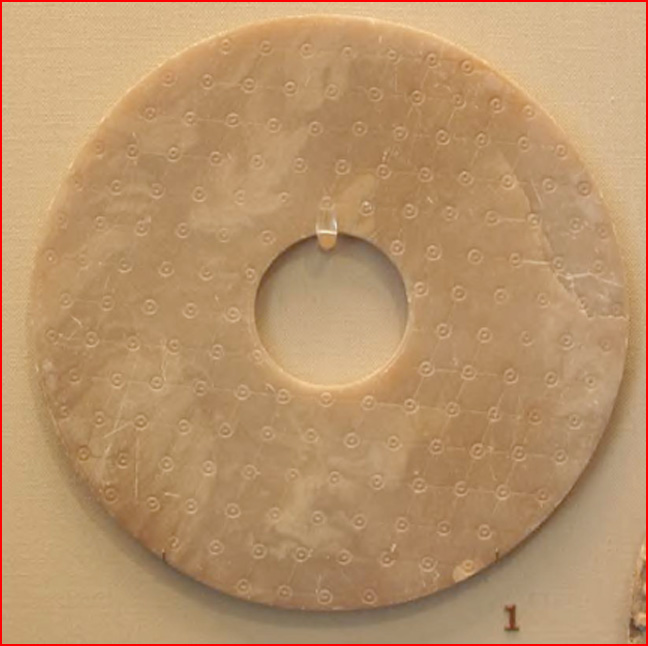
The Hole at the Pole

May 27, 2008


The disc's roundness obviously squares with the common understanding that the sky is circular, if not spherical. But why does it have such a conspicuous aperture in the middle?


Chinese jade disc symbolizing the sky. Credit: Rens Van der Sluijs

Shown here is a so-called bi disc, a Chinese jade disc with a hole in the middle. Such discs, often with a ‘pockmarked’ surface identified as a ‘rice grain’ pattern, have been produced in China at least from the Neolithic period (±2500 BCE) onwards, particularly in the region of Shanghai in southeast China. Certainly during the Zhōu and Hàn dynasties (12th century BCE to 3rd century CE), they symbolized the sky or the cosmos.

Chinese cosmology prominently features the region of the pole star as the center of the cosmos. Yet, surely the Chinese did not envision a gaping hole at the celestial pole? The idea of a hole in the fabric of the circumpolar sky may not have been attested directly in Chinese sources, but abundant traditions from many other parts of the world, such as the Chukchi in northeastern Siberia, postulate precisely that.

The Old Turks used to call the pole star ‘a smoke hole of the sky’. Communities throughout North America subscribed to a belief in “the hole of the sky”, which at least the Lakota and the Blackfoot people specify as being situated “in the northern circumpolar star world”. Gods and goddesses, legendary ancestors and heroes, and the souls of shamans alike are often imagined to use the cosmic hole as a gateway between worlds, a ‘door’ or ‘window’ without which there is no way denizens of the sky can travel to earth and vice versa.

Stargazers may have a hard time trying to figure out just what aspect of the heavenly north pole could have prompted the popular folkloristic image of an opening in the sky. A crucial pointer is the repeated association of the hole with the axis mundi or ‘world axis’: the tip of the tree, mountain, pillar, ladder or rope that ties the regions of the universe together passes through the hole in the sky, and not infrequently the column itself is presented as a hollow object, too.

The Maya people of Yucatán, for example, describe “seven celestial planes, each with a central hole through which the cosmic Ceiba tree extends its branches ….” The sky hole emerges as a property of the complex morphology of the axis mundi.

Intensive collaboration between plasma physicists, electrical engineers and comparative mythologists has recently led to the hypothesis that the mythology of the world axis is convincingly explained as a high-energy auroral z-pinch that formed on the boundary between the Paleolithic and the Neolithic periods, at a time of profound geomagnetic instability.

At times of intense electric flux, this auroral column could have appeared to human eyes as a colossal hollow tube. Visible particles traveling through this tube could have been conceived as animated mythical entities voyaging between the extremities of the cosmos. In this light, the perplexing notion of a hole in an otherwise solid firmament gains plausibility and strikes one for its accuracy in the face of ‘common sense’ observation of the heavens today.


Contributed by Rens Van der Sluijs


Source: http://thunderbolts.info

Fruits, Vegetables And Teas May Protect Smokers From Lung Cancer, Researchers Report

May 31, 2008


Tobacco smokers who eat three servings of fruits and vegetables per day and drink green or black tea may be protecting themselves from lung cancer, according to a first-of-its-kind study by UCLA cancer researchers.

UCLA researchers found that smokers who ingested high levels of natural chemicals called flavonoids in their diet had a lower risk of developing lung cancer, an important finding since more than 90 percent of lung cancers are caused by tobacco smoking.

The study was published recently in the journal Cancer.

"What we found was extremely interesting, that several types of flavonoids are associated with a reduced risk of lung cancer among smokers," said Dr. Zuo-Feng Zhang, a researcher at UCLA's Jonsson Cancer Center and a professor of public health and epidemiology. "The findings were especially interesting because tobacco smoking is the major risk factor for lung cancer."

Flavonoids are water-soluble plant pigments that have antioxidant and anti-inflammatory properties, both of which can counteract damage to tissues. For the UCLA study, researchers looked at 558 people with lung cancer and 837 people who did not have lung cancer and analyzed their dietary history.

Researchers found that study participants who ate foods containing certain flavonoids seemed to be protected from developing lung cancer. Zhang said the flavonoids that appeared to be the most protective included catechin, found in strawberries and green and black teas, kaempferol, found in Brussels sprouts and apples, and quercetin, found in beans, onions and apples.

So should smokers run out and stock up on the teas, apples, beans and strawberries? Quitting smoking is the best course of action, Zhang said, but eating more fruits and vegetables and drinking more black and green teas won't hurt.

"Since this study is the first of its type, I would usually be hesitant to make any recommendations to people about their diet," Zhang said. "We really need to have several larger studies with similar results to confirm our finding. However, it's not a bad idea for everyone to eat more fruits and vegetables and drink more tea."

Zhang said flavonoids protect against lung cancer by blocking the formation of blood vessels that tumors develop so they can grow and spread, a process called angiogenesis. They also stop cancer cells from growing, allowing for naturally programmed cell death, or apoptosis, to occur.

The antioxidant properties found in the flavonoids also may work to counteract the DNA damaging effects of tobacco smoking, Zhang said, explaining why they affected the development of lung cancer in smokers but not in non-smokers.

"The naturally occurring chemicals may be working to reduce the damage caused by smoking," Zhang said.

The next step, Zhang said, are laboratory-based studies of flavonoids on cell lines and animal models to determine how they are protecting smokers from developing lung cancer. And in addition to larger studies to confirm these findings, other studies need to be done to see if the protective effects of flavonoids extend to other smoking-related cancers, such as bladder, head and neck and kidney cancers.

Zhang and his team also plan to study which types of fruits and vegetables have the highest levels of the flavonoids found to be helpful in this study and what the optimal number of servings per day might be to provide the greatest protection.


Adapted from materials provided by University of California - Los Angeles, via EurekAlert!, a service of AAAS.


Source: http://www.sciencedaily.com

Study confirms ancient Chile settlement is 14,000 years old

May 8, 2008


Scientists have confirmed that the famed Monte Verde archaeological site in southern Chile is about 14,000 years old, making it the earliest known human settlement in the Americas, the journal Science reported Thursday.

The age of Monte Verde has been the subject of controversy over the years, since estimates appeared to conflict with other archaeological evidence related to the settlement of North America.

The new findings support not only the age of the Monte Verde site, but also the coastal migration theory currently ascribed to by most scholars, which hypothesizes that people first entered the New World through the Bering land bridge more than 16,000 years ago.

The study, based on the first data compiled about the Monte Verde site in about a decade, identified nine species of seaweed and marine algae used as food by the settlement's inhabitants.

Carbon dating put the age of the seaweed samples at between 13,980 and 14,220 years old, confirming that the site was occupied some 1,000 years earlier than any other known human settlements in the Americas. The study appears in the May 9 issue of Science.

Discovered in 1976, Monte Verde is located in a peat bog about 500 miles (800 kilometers) south of Santiago, Chile.

Researchers say it could have supported between 20 to 30 people in a dozen huts along a small creek.

A wide variety of food has been found at the site, including extinct species of llama and an elephant-like animal called a gomphothere, shellfish, vegetables and nuts.


Source: http://news.yahoo.com

quinta-feira, 29 de maio de 2008

Authentic Viking DNA Retrieved From 1,000-year-old Skeletons

May 28, 2008


Although "Viking" literally means "pirate," recent research has indicated that the Vikings were also traders to the fishmongers of Europe. Stereotypically, these Norsemen are usually pictured wearing a horned helmet but in a new study, Jørgen Dissing and colleagues from the University of Copenhagen, investigated what went under the helmet; the scientists were able to extract authentic DNA from ancient Viking skeletons, avoiding many of the problems of contamination faced by past researchers.

Analysis of DNA from the remains of ancient humans provides valuable insights into such important questions as the origin of genetic diseases, migration patterns of our forefathers and tribal and family patterns.

Unfortunately, severe problems connected with the retrieval and analysis of DNA from ancient organisms (like the scarcity of intact molecules) are further aggravated in the case of ancient humans. This is because of the great risk of contamination with abundant DNA from modern humans. Humans, then, are involved at all steps, from excavation to laboratory analyses. This means that many previous results have subsequently been disputed as attributed to the presence of contaminant DNA, and some researchers even claim that it is impossible to obtain reliable results with ancient human DNA.

Using freshly sampled material from ten Viking skeletons from around AD 1,000, from a non-Christian burial site on the Danish island of Funen, Dissing and colleagues showed that it is indeed possible to retrieve authentic DNA from ancient humans.

Wearing protective suits, the researchers removed the teeth from the jaw at the moment the skeletons were unearthed when they had been untouched for 1,000 years. The subsequent laboratory procedures were also carefully controlled in order to avoid contamination.

Analysis of the Viking DNA showed no evidence of contamination with extraneous DNA, and typing of the endogenous DNA gave reproducible results and showed that these individuals were just as diverse as contemporary humans. A reliable retrieval of authentic DNA opens the way for a valuable use of prehistoric human remains to illuminate the genetic history of past and extant populations.


Journal reference:

  1. Melchior et al. Evidence of Authentic DNA from Danish Viking Age Skeletons Untouched by Humans for 1,000 Years. PLoS ONE, 2008; 3 (5): e2214 DOI: 10.1371/journal.pone.0002214
Adapted from materials provided by Public Library of Science, via EurekAlert!, a service of AAAS.


Source: http://www.sciencedaily.com

quarta-feira, 28 de maio de 2008

10 500BC ~ 2012AD, Fragments of a Lost Civilisation

May 2008


Over the last few decades, monuments have been found under the sea, which were covered up for 12 000 years. These monuments could be much older still. Considering that there are numerous ancient monuments on land that point to 10 500BC, this further reinforces the evidence for a prehistoric civilisation that people are only now rediscovering.

The undersea monuments featured in this video are outposts of something much bigger.


Source: http://uk.youtube.com

segunda-feira, 26 de maio de 2008

Stonehenge builders had geometry skills to rival Pythagoras

26 May 2008


Stone Age Britons had a sophisticated knowledge of geometry to rival Pythagoras – 2,000 years before the Greek "father of numbers" was born, according to a new study of Stonehenge.

Five years of detailed research, carried out by the Oxford University landscape archaeologist Anthony Johnson, claims that Stonehenge was designed and built using advanced geometry.

The discovery has immense implications for understanding the monument – and the people who built it. It also suggests it is more rooted in the study of geometry than early astronomy – as is often speculated.


Mr Johnson believes the geometrical knowledge eventually used to plan, pre-fabricate and erect Stonehenge was learnt empirically hundreds of years earlier through the construction of much simpler monuments.

He also argues that this knowledge was regarded as a form of arcane wisdom or magic that conferred a privileged status on the elite who possessed it, as it also featured on gold artefacts found in prehistoric graves.

The most complex geometrical achievement at Stonehenge is an 87-metre diameter circle of chalk-cut pits which mark the points of a 56-sided polygon, created immediately within themonument's perimeter earthwork.

Mr Johnson used computer analysis and experimental archaeology to demonstrate that this outer polygon was laid out using square and circle geometry. He believes the surveyors started by using a rope to create a circle, then laid out the four corners of a square on its circumference, before laying out a second similar square, thus creating an inner octagon. The points of the octagon were then utilised as anchors for a surveyor's rope which was used to "draw" arcs which intersected the circumference so as to progressively create the sides of a vast polygon.

Indeed, his work has demonstrated that a 56-sided polygon is the most complex that can easily be created purely through square and circle geometry using a single piece of rope.

It is likely that this basic limitation determined the number of sides of Stonehenge's outer polygon – and may also have led to the 56-sided polygon concept becoming important within wider European religious belief. Ancient Greek classical mythology associated just such a 56-sided polygon with Zeus's great rival for divine supremacy, the weather god Typhon.

Johnson's research, published as a book this week, shows that Stonehenge derived its design from geometrical knowledge and features no less than six concentric polygons – a 56-sided outer one built around 2950BC; a regular octagon built around 2500BC) inside that; two concentric (though partly inaccurate) 30-sided polygons built around 1650BC, which were based on a series of hexagons; a 30-sided inner polygon (the sarsen stone ring which was built around 2500BC) also based on hexagonal geometry; and two probable 40-sided concentric polygons (probable former blue stone positions built around 2600BC) that were later modified to 30-sided ones. They also created the famous central stone "horseshoe" utilising the survey markers used to create the thirty-sided sarsen polygon.

The experimental archaeology demonstrates that most of the monument was pre-planned and that the great stones were pre-fabricated off-site and then installed by surveyor-engineers.

"For years people have speculated that Stonehenge was built as a complex astronomical observatory. My research suggests that, apart from mid-summer and mid-winter solar alignments, this was not the case," said Mr Johnson. "It strongly suggests that it was the knowledge of geometry and symmetry which was an important component of the Neolithic belief system."

"It shows the builders of Stonehenge had a sophisticated yet empirically derived knowledge of Pythagorean geometry 2000 years before Pythagoras," he said.

A leading British prehistorian, Sir Barry Cunliffe, from Oxford University, believes that Anthony Johnson's research is "a major step forward in solving the puzzle of Stonehenge".


Source: http://www.independent.co.uk

quarta-feira, 21 de maio de 2008

Creepy Mystic Eye Symbols in Subway Station beneath former World Trade Center

may 21, 2008


This is in the subway stop formerly named "World Trade Center."

It still connects directly to the site, but the part of the station closer has been re-built. A viewing platform has been set up in the closer area to view the "Big Lie Hole." It appears that the mosaic below was not destroyed or damaged and it dates from before the attack.


All over the walls there, single Eyes peer out at you.
The mosaic below is an example.

Every subway station, or most in Manhattan, have a theme. The theme under the former Trade Towers are these Illumanati -style eyes.These particular mosaics were recovered and remounted back into the walls, since they were also the symbols of that subway station before the attacks of September 11, 2001.


This Artwork is built into the floor.
It is surrounded by a guard rail so you can't walk onto it.


It shows a map of the globe with an all-seeing eye at the center.

Someone walked on it to get this picture.


Use of images of public artwork by rights obtaining under Fair Use statute:
For discussion of implications, semiotics, politics and scientific details
surrounding the September 11, 2001 attacks on New York City
see: www.911researchers.com
911 Researchers

blockbush@blockbush.org
© blockbush.org


Source: http://www.blockbush.org

London Olympics 2012 : Zion : Street Plan

20 May 2008


For background reading please read my following posts:

1) London Olympics 2012 : Zion (The New Jerusalem)

2) London Olympics 2012 : The Logo's Creator


I shall start by stating my intentions. With my research, I do not intend to cause panic or fear, or to create a platform for prejudice and hate. As a spiritual person, I publish these views in order to simply raise awareness. To raise awareness on the grounds, that if indeed something does transpire during the London Olympics 2012, you can observe the event with a critical eye. It is my intention to ensure we shall not be duped!

Following my two previous articles concerning the Olympics 2012, I decided to cast my eyes into the air and look down again. You guessed it, out came Google Maps.

Here's a satellite view of the Olympics 2012 Site:

satellite

Stratford in London, is to become host to the Olympic village, which is undergoing massive regeneration due to the project. The site was claimed to be the last area of suitable waste land in London. Pretty lucky eh? Or maybe it was left alone for years for this very reason! I choose the latter.

And so... to the point. Take a look at the Olympic site with the Google Maps road view. On a first glance it looks like any other map view, but persevere... take a closer look at the road names (click to enlarge):

olympicsroads

You will find that the entire site of the Olympic Village is surrounded by somewhat biblical and mystical road names. The New Jerusalem you ask?

The Roads

1. East Cross Route (actually the A12 or A'20'12) : ref. "The Eastern Cross"

The Eastern Orthodox cross (also known as Crux Orthodoxa, the Byzantine cross, the Eastern cross, and the "Russian" cross) can be considered a modified version of the Patriarchal cross, having two smaller crossbeams, one at the top and one near the bottom, in addition to the longer crossbeam.

Notice how the East Cross Route is also an A road - numbered A12.

Given the UK has hundreds of A roads, what's the likelihood that of all roads, the A'20'12 intersects the Olympic site?

Pause for a second and think about the shape of the letter A... yes it's a pyramid with a capstone. So symbolically the only major road which 'crosses' the Olympic site, is the A(Pyramid) (20)12.

2. Carpenter's Road : ref. "Joseph"

Joseph's profession is described in the Gospels as a τεκτων, a Greek word for a variety of skilled craftsmen, but Christian tradition has him as a "carpenter".

3. Great Eastern Road : ref. Eastern Star

The Order of the Eastern Star is the largest fraternal organization in the world that both men and women can join. It was established in 1850 by Rob Morris, a lawyer and educator who had been an official with the Freemasons.

Logo Of The Order Of The Eastern Star

As you can see the emblem for the "Order Of The Eastern Star" is a pentagram - similar to that found on the UK Passport. An acknowledgement of the pagan deity Satan / Saturn.

4. Angel Lane : ref. Angel Gabriel / The Holy Spirit

Angels visit Joseph and Mary. Angels announced Christ's birth to Mary and Joseph. The angel Gabriel visited Mary in Nazareth. She was engaged to Joseph. Gabriel told Mary she would give birth to the Son of God. Mary was a virgin. Gabriel told her God's power would make the conception possible. Gabriel said, "Nothing will be impossible with God".

5. Temple Mills Lane

Temple Mills were water mills belonging to the Knights Templar - "The Poor Fellow-Soldiers of Christ and of the Temple of Solomon".

6. Church Road (Update)

Although not shown on the above map (but please do look in Google), the road on the north east perimeter of the complex takes it's name from the Christian place of worship, a church.


The Location - Ley Lines

The Olympics 2012 site is situated between Leyton and Leytonestone. The "Ley" found in their names originates from the term 'Ley lines'.

For those who are in the dark:

Ley lines, or Leys, are alignments of ancient sites stretching across the landscape. Ancient sites or holy places may be situated in a straight line ranging from one or two to several miles in length. A ley may be identified simply by an aligned placing of marker sites, or it might be visible on the ground for all or part of its length by the remnants of an old straight track.

Our ancestors knew that ley lines, earth grids and vortexes were energy sources and centers that were to be considered holy.

A "Ley Line" is one a number of lines which form part of an energy grid which cross the Earth. The energy - metaphysical in nature.

So is there any documentary proof that 'Ley lines' cross near Leyton and Leytonestone? You bet there is...

The bender site, and the old yew tree in it, were the short-lived heart of Leytonstonia, decorated with a kerb-henge, a replica of Stonehenge made with kerbstones. (Some talked of the significance of the names Leyton and Leytonstone, of their relation to ley lines more generally, as though this might explain the energy of the protest sites. A brickhenge was made at Clarement Road, halfway between Leyton and Leytonstone.)

The Olympics site lies in an area synonymous with mystical - metaphysical - earth energy. Is this yet another coincidence or part of a plan for the 2012 Olympics which was put into motion way before the event was officially finalised?

Conclusions

It seems the Olympics 2012 site was picked for reasons which go far beyond that of 'spare waste land'.

The roads which encompass the site, contain biblical and Masonic references, lying dormant for years, as if to become part of some majestic ritual.

And if that wasn't enough, a new construction intersecting 'Angel Lane' looks to be forming a grand procession.

In the BBC interview "It will be a lasting legacy" with Jean Pickering, the former Olympic bronze medallist was quoted as saying:

I remember running along Angel Lane to get the train to work and hearing all the market stall holders cheering me on. That's true East End spirit.

References to 'lasting legacy', 'Angel Lane', and 'true spirit' sound ominous to me, given our 'Zion' street map.

Britain's spiritual landmarks - Stonehenge, Glastonbury Tor and Avebury, all rest upon 'ley lines' (areas of intense earth energy). Could it be any more bewildering that they have chosen such a site for our Olympic games? And that it just so happened to be vacant for the occasion?

To close I would like to end with a reference from the Bible. Note the chapter and verse numbers.

Mark 11:11

Then Jesus went into Jerusalem and into the temple and looked around at everything. Since it was already late, he went out with his twelve disciples to Bethany.

At 11:11 (find out more here), Jesus enters Jerusalem, or should that be the New Jerusalem - Zion!


Source: http://thecosmicmind.blogspot.com

domingo, 11 de maio de 2008

The continent's true history

May 1st 2008


Protecting cave paintings can restore Africa's pride in its history


Africa, Arise

SO LATE to be “discovered” by the rest of the world—Henry Stanley made the continent's first crossing only in 1877—Africa, it can be forgotten, is probably the cradle of humanity. Palaeoanthropologists, archaeologists and, more recently, geneticists have all bolstered the “out of Africa” theory, which holds that early man wandered out of the Rift Valley. Yet little is known of pre-colonial African cultures. Some vanished out of history, along with their languages and beliefs, before they ever came to be named. That is one reason why Africa's rock art is so precious. The faintest ochre scratches of prehistoric antelope in a cave open a rare window into Africa's—and humanity's—distant past.

Africa may have 200,000 rock-art sites, more than any other continent. The oldest known site, in Namibia, is between 18,000 and 28,000 years old. Several African universities now have programmes to decipher the paintings and carvings. They are being helped by the Kenya-based Trust for African Rock Art (TARA), which seeks to discover and digitally archive as much of the art as it can for future scholars.

The best is in the Sahara desert, particularly in Niger's Air mountains, in the Tibesti mountains of northern Chad and southern Libya, and in south-east Algeria's Tassili n'Ajjer range. Such desert sites are too remote to be damaged by graffiti, though wars involving the local Tuareg have resulted in some being shot up or smashed apart for sale to foreign collectors. David Coulson, one of TARA's founders, raves about a recent find in the Tassili n'Ajjer range: an anatomically perfect four-metre-long carving of a hippo hunted by an Egyptian-looking figure with a superbly sinuous bow. This in a region that dried up several thousand years ago.

Elsewhere in Africa, rock art often chronicles the hunting magic of Bushmen and Pygmies. Not much rock art survives in western Africa, and in eastern and central parts of the continent more recent but still invaluable paintings have been poorly preserved.

But there is progress. Locals are being encouraged to see the value of showing off their sites to tourists. National museums are being overhauled, with new displays of lost peoples. New history textbooks may follow. New finds are being made. A sensational discovery in a cave in Kenya is being kept under wraps until it can be properly dated.

Some think African rock art should provide a pan-African rallying point, free of politics or religion. A rich rock-art heritage could connect Libya and South Africa, two of the African Union's biggest backers, which sometimes struggle to find anything in common. Kofi Annan, a former UN secretary-general, is a big rock-art fan. He reckons it represents nothing less than the earliest record of the human imagination.


Source: http://www.economist.com

Pi, Phi and the Great Pyramid

may 11, 2008


We can forget all the ideas crediting Atlanteans or space aliens with building the Great Pyramid of Giza, and instead imagine ourselves travelling back in time in H G Wells's time machine to try and work out not how the ancient Egyptians built this enormous edifice, because this lies beyond our present understanding, but rather what we can best judge to be its most appropriate proportions. Then, however, there were no electronic calculators, only ropes and rods.

Constructing right angles at the four corners of a pyramid is easy. To do it, history tells us that the Egyptians were aware of the ratios 3:4:5 as the side-lengths of a right-angle triangle. Many old kingdom pyramids adhere to these ratios. The Egyptians also knew a rough value of Pi (the value, not the symbol) as the ratio between the circumference of any circle and its diameter. They worked out that 3 _ is less than Pi, and Pi is less than 3 1/7, i.e. Pi lies between the rational number 22/7 and the Babylonian value. This can be done by constructing a circle of diameter AB and laying the latter on its circumference, starting from A, once until C then D then E, to conclude that Pi is greater than 3. The remaining part EA from the circumference is laid down again on the diameter AB, so seven times EA is less than AB which in turn is less than eight times EA, or EA/AB is greater than 1/8 and less than 1/7.


Read the full story at: http://weekly.ahram.org.eg/2008/890/heritage.htm

segunda-feira, 25 de fevereiro de 2008

Star Flips its Magnetic Field

by Fraser Cain

At some point in the last year or so, the Sun-like star tau Bootis completely flipped its magnetic field. The star's north pole became its south pole, and vice versa. It this going to happen to our own Sun? Yes! Don't panic though; in fact, it happens every 11 years or so.Even thought the Sun's magnetic field flip has been well observed, astronomers have never seen this happen on another star. With the Sun, the field reversals are closely linked to varying number of sunspots on its surface. The magnetic field flip happened last time in 2007, when the Sun was at the "solar minimum".


The Earth has been recorded to change its magnetic field too, but this event has happened very erratically in the past, and theres no way to predict when it's going to happen again in the future.
And international team of astronomers were watching the star tau Bootis with the Canada-France-Hawaii Telescope Mauna Kea as part of a survey measuring the magnetic field of stars. On one sweep the star had one configuration, and later on, the magnetic field was reversed.


Since this event happened within just two years of observations, it's likely that tau Bootis flips its field even more quickly than the Sun's own 11-year cycle. Even more interesting is the recent discovery that the star is orbited by a massive planet. It's a hot Jupiter planet, six times the size of Jupiter, but only 1/20th the distance from the Earth to the Sun.


The planet is so close, it has become tidally locked with the star, similar to the way the Moon only shows one face to the Earth. It's possible that the tidal interactions between the star and the planet somehow speed up the surface of tau Bootis, and encourage these magnetic flips.


The astronomers are planning to keep their telescopes firmly targeted at tau Bootis, checking the magnetic field of the star regularly. If it flips again, they'll be ready.


The research was published this week in the British journal Monthly Notices of the Royal Astronomical Society.


Original Source: Institute for Astronomy News Release


Source: http://www.universetoday.com

Trailer: Architects of control

Michael Tsarion Red Ice Creations
Architects of Control © 2008


The Eyes Have It

February 9th, 2008


Write “Lord have mercy on us” on those three;They are infected; in their hearts it lies;They have the plague, and caught it of your eyes
-William Shakespeare

It goes by many names; the cursing eye, sick eye, eye of envy, hairy eyeball, sour eye, beating with eyes, the devil’s eye, even the rather cute name “fat eye”. Regardless of what you call it, it is one of the most widely held and deeply believed superstitions in the world. From the American South to South America, Portugal to Poland, Iran to Israel, everyone fears the Evil Eye.

The lingering gaze, the outright stare, the “over-looking” of a stranger can make the skin crawl, and perhaps for good reason. The dangers of the evil eye range from the mild, moths attacking clothing, accidents involving furniture (Dick Van Dyke comes to mind) and sour milk, all the way up to fire, sickness and the downright deadly. Children are thought to be especially susceptible to what Italians fearfully call the malocchio.

The concept of the evil eye predates all major religions and can be traced back to the very earliest of human records. Starting in the middle east, the belief made its way across Europe and Asia. While Medusa is perhaps the most famous practitioner of the evil eye, the Hindu god Shiva can also shoot a deadly burning beam from his third eye, and even Socrates was accused of possessing the evil eye with which he held his students in a demon trance. Even a Pope was said to have the evil eye. “Pope Pio Nono was supposed to be a jettatore (evil eyer), and the most devout Catholics, whilst asking his blessing, used to point two fingers at him.”
From the protection of the Egyptian eye of Horus to the Masonic eye of providence staring blankly out off of the US dollar bill, eyes can represent power, knowledge, and in this case, grave danger. The exact causes of the evil eye varies from region to region, but it almost always involves envy on the part of the caster. People with blue or green eyes are said to be more likely to cast the evil eye, though often people may not even be aware they are casting it. From crystalinks

“In Jewish religious thought, it is sometimes asserted that the one who looks upon another with envy is not always at fault, but that the envy may be perceived by God, who then may redress the balance between two people by bringing the higher one low.”
Compliments can be a dangerous thing
The concept of the evil eye was brought all the way to the American South by the publication of Henri Gamache’s (a nom de plume) book “Terrors of the Evil Eye Exposed” in 1946. Later republished as “Protection Against Evil,” the book was aimed squarely at black Southern practitioners of Hoodoo. Hoodoo is a system of folk magic and a sort of superstition catch all. (It should not to be confused with Voodoo, though it does draw from that, as well as Christianity, European magic texts and Eastern religions.) Spells for repelling the evil eye quickly became standard among Southern Hoodoo practitioners.

In Edgar Allan Poe’s “The Tell-Tale Heart,” the narrator kills the man because of his evil “vulture eye”, but thankfully there are other less extreme measures. While traveling through Turkey, M and I were overwhelmed by the sheer number of what are called Nazar, or evil eye protection charms. Beautiful blue glass eyes hang from every available surface and adorn even the airplanes. Known as apotropaic (something that can ward off evil) the protections come in almost as many forms as their are believers.
(Hanging numerous Nazar’s off of a tree, is a sort of double protection. As the evil eye is often cast towards ones home, livestock or fruit trees a charm burdened tree acts as a sort home security device. Similar in purpose are bottle and pottery trees.)

Greeks have a ritual called xematiasma and use oil in water to test for the evil eye. Should one test positive (reveled often by a eye shape of the oil) they then perform a semi-secret pagan-cum-Christian ritual where the healer, usually a family member of the opposite sex, lick their fingers, performs the sign of the cross three times, and spit in the air three times. Believers in the Kabalah tie a red string around their wrists to ward off the evil eye.
In South America, eggs are used to absorb the evil while in parts of the Middle East, children are marked upon to make them unattractive, and boys are occasionally disguised in girl’s cloths to fool the evil eye. Italians have numerous protections, but they include a Cornicello, a small amulet of gold, silver, or red coral. In ancient Rome such an amulet was called a fascinum, as in to block “fascinators” who might cast a spell or “fascinate” them.

But the greatest modern protection against the evil eye was made through the work of an unsuspecting Italian American rocker, one Ronnie James Dio. Growing up in an traditional Italian home, Ronnie was accustomed to seeing the horned hands or “mano cornuta” displayed against the evil eye. All crescent shaped objects ward off evil (hence the lucky Horseshoe) and the horned hand (representing pre-Christian minotaur horns, not devil horns) was yet another way of warding off bad luck and the evil eye. Though it was, on occasion, was deployed at the wrong times. From wiki
“President of the Italian Republic Giovanni Leone shocked the country when, visiting Naples during an outbreak of cholera, shook the hands of the patients with one hand, and with the other, behind the back, made the corna. This act was well documented, as all journalists and photographers were right behind him, a fact that had escaped President Leone’s mind in that moment.”

Ronnie James Dio’s grandmother often deployed the horned hands and when Dio became the front man for Black Sabbath, he replaced Ozzy Osborne’s peace symbol with the corna or as most of us know it, the metal hand. From an Interview with Dio at Metal-Rules.com

“It was symbol that I thought was reflective of what that band was supposed to be all about. It’s not the devil’s sign like we’re here with the devil. It’s an Italian thing I got from my Grandmother called the Malocchio. It’s to ward off the Evil Eye”

Though not necessarily the first to ever use it in a “rock” setting, Dio was without question the one who turned it into a popular symbol. So while legions of rock fans test their metal (as it were), they are also unconsciously forming an enormous protective shield against the power of the evil eye. The next time you feel the uncomfortable gaze of a stranger and fear the wrath of the evil eye, perhaps the safest place to go is your nearest heavy metal venue.


Source: http://curiousexpeditions.org

domingo, 24 de fevereiro de 2008

Giant crystal hidden in Earth's center

14.02.2008


Our picture of the inner core is pretty simple—a lump of solid iron, made up of microcrystals with some defects and soft boundaries. However, recent measurements of seismic waves revealed that sound waves travel faster through the inner core along the Earth's axis. Looking even closer revealed that the speed up didn't begin immediately on entering the inner core, but began a few kilometers below the interface between the outer and inner cores.
To explain the anisotropic speed of sound in the inner core, some researchers had proposed that the inner core was, in fact, a single giant crystal with the hexagonal structure pictured to the far right. The hexagonal structure is justified because experiments and calculations have revealed it to be the stable structure adopted by iron under high pressure and temperature.

If this crystal was oriented along the Earth's axis and had lots of defects near the surface it might explain the observations. Considering that the Earth has had a few billion years to slowly cool, it is not so far-fetched to imagine a single large crystal in the center of the Earth.

The problem is that we can't easily replicate the conditions experienced by the iron in the inner core. We can manage the temperature or the pressure fairly easily—explaining why scientists proposed the hexagonal structure in the first place—but not both simultaneously, making it difficult to figure out if hexagonal iron has the right properties to explain the seismic observations. The single hexagonal theory was dealt a serious blow when calculations showed that although the hexagonal structure is stable at high pressure and temperature, it is also isotropic, meaning that sound has the same speed along every orientation, Science reports.

This is a lovely piece of research because it shows how an awkward, but sort-of works, solution can be replaced in one step. We started out needing to assume a single, oriented crystal in the Earth's core and replaced it with a morass of crystals, with only a minority of them aligned. In doing so, two unexplained observations were explained: the speed of sound, and its anisotropy in the Earth's inner core.


Read also ‘Largest diamond in galaxy predicts future of solar system’

and ‘13 crystal Maya skulls will save the world ’


Source: http://english.pravda.ru

Russian scientists contact nether world

Translated by Lena Ksandinova
19.02.2008


Sesnational news from the spirit-world came just the day 2 planes crashed in Russia. While Federal Security Service staff was clearing away the wreckage in the places of the accident in Rostov and Tula regions, the scientists of Saint Petersburg already knew that was an act of terrorism. They got interested strange sounds heard in the ultra short waves that are free from radio signal. When the scientists scrolled down the record, they were astounded. It said: That was a terrorist”.

That was a sensation. The words were replayed on “Saint Petersburg Radio” air. Non-believers finally realized that the other world really exists.

A University of Radio technique professor Artem Mikheev got interested in this question. He found “Russian Instrumental Transcommunication” – an organization aimed to cooperate with the nether world.

Such attempts were undertaken from ancient times. Shamans and oracles got in trance to hear voices from other planets. Then came spiritists with the attempts to read notes from the other world my means of rolling a saucer. They both found out that sometimes spirits could reveal secret information about people and places and even anticipate events.

Vyachelsav Mesherakov, an expert on the history of spiritualism, claims that some magicians even managed to revive people’s dead relatives for a short time. These ghosts behaved like zombie, although looked like themselves while alive. Spiritualism’s opponents, however, claimed pictures of these zombies fake.

From the invention of radio on free from broadcasting range strange voices started to appear in the background. In 1949 Marcelo Becky, Italian, started to record them, and it turned out that these voices can be answered.

Inspired by the experience of foreign scientists, Artem Mikheev started his own experiments in 2002. Ghosts’ answers came to Artem even when the microphones were off.

Mr. Mikheev says that on the day of the planes crash he was establishing connection with the other world. They didn’t know what the cause of the tragedy was, so they turned to the strange voices for an answer. The answer was a quick messy record. Artem slowed the speed down 2,5 times, and heard somebody saying: “That was a terrorist”. Several days later this information was officially confirmed.

Artem Mikheev is convinced that life after death exists. During one of the spiritual operations Artem asked if people and animals have the same size after death, the voice said, “You resemble wavs”.

Source: http://english.pravda.ru

sábado, 23 de fevereiro de 2008

A semana em que “Deus” morreu

Timothy BANCROFT-HINCHEY
23.02.2008


Esta semana, a noção de que a decência comum e a legalidade têm alguma importância, o preceito que o estado de lei tem mais poder do que a lei da selva, foram varridos com um golpe mortal, proferido por uma mão-cheia de países que, num momento de loucura, desrespeitaram séculos de progresso no sentido de construir uma comunidade internacional baseada num estado de lei global.
Desde os tempos clássicos, a humanidade tem tentado encontrar uma identidade comum baseada em amor pelo próximo, baseado no princípio de relações entre irmãos, baseado numa compreensão e confiança mútua. Esta procura viu gerações de seres humanos apanhados num pesadelo ao longo dos séculos, em que parecia que o Bem era uma pequena ilha num mar de maldade, em que os feitos do Diabo eram muito mais evidentes do que os de Deus.

Aqueles tempos escuros levaram a Humanidade numa viagem através da Idade Escura, com as migrações massivas e massacres de povos inteiros, limpeza étnica e genocídio numa escala não imaginável, através da Idade Medieval e Período Moderno, em que o Homem procurou o caminho na direcção de aquilo que era justo.

Os males da Inquisição, os anos de intolerância religiosa, deram lugar ao entendimento que novos princípios tinham de ser encontrados e seguidos, princípios mais pertos dos ensinamentos de Deus e seus profetas, deram lugar à constatação de que a Governação tinha se ser baseada em responsabilidade colectiva.

Através destes séculos, tratados de paz, e não massacres, seguiram as guerras e em 1648, o Tratado de Westphalia construiu os alicerces da Europa moderna, estabelecendo o reconhecimento generalizado da liberdade de expressão religiosa, implementando pela primeira vez a aceitação que os homens poderiam ser diferentes, mas iguais sob o mesmo conjunto de direitos humanos.

Outros tratados prepararam o caminho para a implementação da Liga das Nações e mais tarde, a ONU, reforçando esta filosofia. A Carta da ONU (1945) estabeleceu regras claras para a práctica da diplomacia num mundo supostamente multipolar. Trinta anos depois, o Acto Final da Conferência sobre Segurança e Cooperação na Europa, assinado em Helsínquia, reconheceu as fronteiras europeias como invioláveis.

Levou a Humanidade quase dois mil anos para chegar a um estado em que foi criada uma Irmandade de nações, onde regras claras e fundamentais tinham sido aceites, proclamando que todos os seres humanos eram iguais e todas as sociedades e povos tinham o direito à nascença a viverem nos seus lares em paz.

Finalmente, tinha sido criado um estado de lei universal; finalmente, os preceitos nobres estipulados nos escritos das grandes religiões se tornaram realidade. A regra da lei, e a palavra de Deus, tinham vencido. A lei de Deus, os princípios de Deus, na terra de Deus.
Levou os governos de Clinton e Bush menos que uma década para desmantelar estes séculos de progresso e esta semana, ainda no início do Terceiro Milénio, a lei da selva voltou, varrendo quaisquer noções de que a lei internacional é vinculativo através de qualquer código de honra.
Em declarar seu apoio para um Kosovo Albanês independente, a mão-cheia de nações liderados pelos EUA, Reúno Unido, França, Itália, Áustria e Alemanha disseram de viva voz que os tratados nem valem o papel em que são escritos; estes países admitiram que nem respeitam a lei, nem a ONU, nem a sua Carta, nem qualquer preceito que as decisões devem ser tomadas numa base multilateral.

Meia dúzia de congressistas e senadores nos EUA entenderam que por criar uma Grande Albânia (que irá seguir), primeiro as Balcãs e depois o resto da Europa, seriam divididos e destabilizados durante muitos anos. Divide et impera . Por sua parte, os países europeus que seguiram os passos dos norte-americanos, ou venderam suas almas e seu carácter a Washington DC ou então entenderam que só por criar um Kosovo independente podem livrar-se da praga de refugiados kosovares e a sua nefasta influência nos países anfitriões. Não é por acaso que são esses os países europeus com maior número de refugiados kosovares.

Esta semana, soltaram o Diabo com a bênção de Washington, Londres, Paris, Berlim, Viena, Tirana, Cabul, Ankara e Roma. Que o livro da história registe esses nomes, esses países e seus governos como aqueles responsáveis por fazer o trabalho do Demónio, destruindo os nobres preceitos para os quais a Humanidade lutou tanto e por tanto tempo, nesta semana em que o “Deus” morreu.

Porém, apesar disso, não quer dizer que om Kosovo independente existe. Os cidadãos do mundo têm uma escolha – aderir à lei e dar uma mensagem clara aos governos que andam de mãos dadas com a máfia kosovar que não têm o direito de destruir o tecido das relações internacionais, ou, então, como estes, vender suas almas ao Diabo e dar as boas vindas a uma Nova Ordem Mundial gerida por gula, hipocrisia, assassínio e uma mão cheia de barões invisíveis que manipulam o resto da humanidade para servir seus próprios meios.

quinta-feira, 14 de fevereiro de 2008

Neurónios têm mais importância individual do que se pensava

24 de Dezembro 07


Os neurónios têm, individualmente, um papel mais importante do que se julgava até agora, segundo estudos que melhoram a compreensão das interacções entre células do cérebro e que descrevem a influência de um só neurónio na percepção.

O estudo, publicado na revista Nature, revela que cada neurónio, tal como uma árvore com várias raízes que procuram o contacto umas com as outras, estabelece conexões, as chamadas sinapses, onde os mensageiros químicos (neurotransmissores) asseguram a comunicação com os neurónios vizinhos.

Ao nível de cada sinapse, a informação ou ordem, é assim transmitida entre um neurónio "pré-sináptico" e um neurónio "pós-sináptico".

Quando de um processo de aprendizagem, certas sinapses são reforçadas e algumas conexões são privilegiadas.

Os trabalhos de Christopher Harvey e Karel Svoboda, do Instituto Médico Howard Hughes, nos Estados Unidos, mostram que os efeitos de um só neurónio sobre a plasticidade cerebral, ou seja a capacidade do cérebro em aprender e a adaptar-se ao modificar as conexões, são mais importantes do que se havia demonstrado até agora.

Para além do 'diálogo' directo entre neurónio pré-sináptico e neurónio pós-sináptico, a conversação estende-se a outras células nervosas vizinhas.

O estudo, efectuado em ratos, dos neurónios do hipocampo, a região do cérebro que intervém na memória, mostra que a plasticidade de uma sinapse «pode ser influenciada por eventos em sinapses vizinhas», revelam os investigadores.

Estas interacções locais entre sinapses, cujos efeitos se estendem a uma distância de 0,01 milímetros, e que continuam durante um máximo de dez minutos, podem reforçar ou facilitar as conexões entre neurónios próximos.

A descoberta desta forma de cooperação entre sinapses próximas «abre várias pistas de pesquisa», sobretudo para compreender os mecanismos celulares, afirma num comentário Barnado Sabatini (Havard Medical School, Boston, Estados Unidos).

Num outro estudo, Michael Brecht (Universidade Humboldt, Berlim) e o seu colega Arthur Houweling, conseguiram modificar num rato a reacção ao toque ao estimular electricamente um só neurónio do córtex.


Source: http://tsf.sapo.pt

FREE ENERGY: Home Generator - Zero Point Energy - Off the Grid

Fevreiro 2008


FREE ENERGY:
Home Generator
Zero Point Energy
Off the Grid
Is this the end of the internal combustion engine? Will wefinally be able to drive past gas stations with a friendly wave and a honking horn? Will we be disconnecting from the power grid or even selling power back to the electric company?
We're about to find out.


Watch the video here: http://www.youtube.com/watch?v=efCelx7qe_M


Source: http://www.youtube.com