By Jennifer Viegas
Bowl dated between late 2nd century B.C. and the early 1st century A.D.
Read the full story at: http://www.msnbc.msn.com
project
In 1915 the prosecuting Bishop had finally won a judgment against the Abbe Sauniere for the non-disclosure of his abundant funding. Sauniere would not reveal his source and lost his parish over the secret. Despite losing his position, Sauniere had no intention of leaving his estate on the mountain, he had ordered 8 million francs worth of further construction to his properties including a pool and paved roads - the mysterious funds were back in abundance. Two and a half weeks later he was dead.
In the famous letter from Fouquet concerning the painter Poussin, he states that Poussin had mysteries to convey that even kings could not get out of him. The problem was that Poussin had just been called back to France to give an account to the king concerning this privileged information, which Poussin kept from His Majesty. Who was behind Sauniere and Poussin that gave them such bravado in the face of higher authority?
After the French Revolution, Catholic clergymen were warned against royalist sentiments. Before the days of the media, the priests were the formers of public opinion and they were told that, "The days of kings are gone!" When the priest Sauniere gave his anti-Republican (anti-Revolutionary) speech, he was reprimanded and sent to the monastery in Narbonne. After his time there, the Countess of Chambord donated money to him for the renovations of his parish at Rennes-le-Chateau. She was living in exile in Austria. Theobald Hautpoul was the tutor of her children. Her motives were two-fold, she was after the parchment documents hidden somewhere in his church that concerned her Merovingian genealogy. When Sauniere went from clue to clue and found the pages she was looking for, his life changed and he became a wealthy man. There was a line of communication between Sauniere and the Countess through her doctor. This exiled royal line was not only the first source, but the major source of his funding all along. It was at the behest of the Countess that Sauniere began to "remodel" the church graveyard, the famous Hautpoul tombstone was defaced at that time. Did he do this at her request? The Hautpouls and de Negres were Masonic families. Freemasons were known to have requested burials accompanied by Masonic ornaments (called "Masonic Jewels") and documents, a graveyard could be a treasure trove of information. On the other hand, the trigonomic map on the Marie de Negre - Hautpoul tombstone could point treasure hunters directly to the secret royal storehouse and was perhaps too obvious.
There has been so much speculation as to the source of Sauniere`s wealth. In an area where Templar ingots of Arab gold coins weighing 50 kg were being plowed up by local farmers, the Abbe Sauniere could have made such a discovery himself. It is more likely that Sauniere`s disguised Hapsburg visitor continued to bankroll the priest and since this royal Hapsburg relative planned to fake his own death, Sauniere had to keep his benefactor a secret. The Serbians were plotting against the Hapsburg family and had trailed Sauniere`s visitor up to the Languedoc. There are further clues that these assassins were the ones who killed Abbe Gelis. The police determined from his multiple head wounds that the murder of the 70 yr. old priest was the work of a gang and not a lone murderer. Also, the "note" that was left behind was written on a "Tsar" brand pack of cigarettes. It proclaimed "Viva Angelina!" a Serbian saint in the Russian Orthodox Church. The killers did not recognize the Catholic Church in France or Austria and they eventually assassinated the Hapsburg heir to the Austrian throne triggering World War I.
Just because the source of Sauniere`s wealth has been discovered to be from the royal line that had been expelled from France, it does not mean that the famous secret treasures of the Languedoc were not an important part of his life. Indeed, his mentor was a member of the secret society that protected the royal storehouse from generation to generation.
The relics of the church in southern France have survived much turmoil from the invasion of the Moors to the French Revolution. Through the centuries, this organization of mostly priests has protected the relics and statues until it was safe to display them in the cathedrals once again. Many priests took the secret of the whereabouts of these treasures to the grave with them in times of war. In 1892 Bernard Ponges wrote that, "Boudet and Billard were eminent members of an underground religious fraternity." It was Boudet who had written a book about the Megalithic and Celtic ruins in the area and Sauniere was his protégé.
The legends of the fortress and the fortified keep in the area are true, but the identification of Rhedae of the Razes, the capital of the Visigoths, as Rennes le Chateau is in error, perhaps a deliberate error considering the element of secrecy that abounds in this place. In the Archives of Malta there is a reference to the district of the Aude, a Templar parchment referring to "Reddas" mysteriously disappeared from there along with the Chalice of Malta. An article by Mgr. Georges Boyer, Vicar-General covers the Visigothic past of the Rennes-le-Chateau area and the treasure hunting activity going on there, "We affirm without any hesitation that a treasure is hidden in an ancient necropolis, the existence of which is known to the bishopric of Carcassone, but about which she refuses to unveil the secret." In 1870 the author Firmin Jaffus wrote that "The Treasure of Solomon is buried either in Limoux or in Carcasonne." There were rumors that the Templars possessed vast underground complexes in the region. The Archives of Malta also mention the Templar occupation of Notre Dame de Marceille by 1269. Notre Dame de Marceille crowns a hill just outside Limoux which is north of Rennes-le-Chateau in the district of the Aude. The Aude River flows through the Rennes-le-Chateau area in the foothills of the Pyranees Mountians close to the Spanish border. The village of Limoux is 2000 years old and was built on 7 hills in imitation of Rome. The priests of Mars were the Roman forerunners of the Lazarist order which resides there now. These Lazarists were invited to Rennes-le-Chateau for the rededication of Sauniere`s remodeled parish church. The Countess of Chambord and her husband Henry V were interested in Notre Dame de Marceille despite being in exile. She donated to that church a Byzantine icon of the Madonna and child "engraved or corrugated in silver and gold, filled with precious stones" which was placed above the famous statue of the Black Madonna. Was the famous "secret" of the 17th century society of cognocenti the mysterious underground complex of Notre Dame de Marceille kept hidden by the Lazarists and the resident hermit who kept visitors and pilgrims away from the vaults near the river?
Theophile Lasserre, priest of Alet-les-Bains and co-owner of Notre Dame de Marceille which he had inherited through his family, relates an episode from the conflicts in southern France. "Thus undergoing the rage of the Muslims, the knowledge of this rich deposit and its whereabouts was carried into exile by faithful ministers, or went with them to the grave. The Moorish invasions would last for more than a century. The historian Marca states that to avoid persecution, the archbishops of Narbonne were obliged to take refuge in the stronghold of Redda - believed to be the modern Rennes-le-Chateau. This city was the capital of the Razes for more than a century, when the invasions continued." According to Lasserre, the treasure mentioned is that of Notre Dame de Marceille. Also, Rennes-le-Chateau is not really a stronghold, but Notre Dame de Marceille is. It was originally a Roman fort with a well inside and was later a Visigothic and then a Templar fortress. It is perfectly situated, being on a hill near a river. The nave was added to the original fort in the 16th century and the tile work on the floor displays the Star of David pattern used in the Languedoc, denoting the royal Jewish heritage of the area. Jean-Luc Chaumeil writes that the Bibliotheque Mazarin contains a document listing all the ancient places and their communities. On page 122 and 123, one Monsieur Roux has written on Limoux: "Limoux is mentioned for the first time in 854, in a document of Charles of Chauve, in favor of Ana, abbot of St. Hilaire, in the diocese of Carcassonne. As a result, certain authors have stated that this city existed in the time of Julius Caesar and that it was defended by a castle named Rhedae." "From the side of the mountain, where in the past the city of Rhedae stood, Limoux presents a more picturesque view."
This suggests that the Visigothic capital of Rhedae was not Rennes-le-Chateau, but Limoux and that the most important aspect of the town was the castle, not the castle of Rennes-le-Chateau, but instead a castle over-looking Limoux: perhaps Notre Dame de Marceille? This site had both a religious and military purpose. Poussin, Sauniere, and the Secret Society
At the time of the famous Fouquet letter concerning Poussin, the complex of Notre Dame de Marceille was owned by Fouquet`s brother, this area was the secret that the secret society had kept hidden for centuries. Poussin was also a member of this society, an honor usually reserved for priests. The letter about him referred to something hidden that could be used to make money. Two centuries later, Marie Denaurnaud, companion to Beranger Sauniere, hinted to the buyer of the Villa Bethania after Sauniere`s death that she would relate to him her secret which he could employ to make himself a fortune. She hinted that he was walking upon hidden wealth.
Both of these inferences imply an ancient craft, the ability to turn lead into gold - the art of Alchemy! Some authors credit Sauniere with knowing magic which is essentially of an alchemical nature. Pierre Plantard once said that Saint Vincent de Paul was never really kidnapped by Arab pirates but was really at Marceille learning alchemy with "Jean the Alchemist" in the castle of Barbarie known as "The Occult Bastion of France." Louis XIV had that castle dismantled in 1659 on an order from Cardinal Mazarin.
References to alchemy abound in the mystery of Rennes-le-Chateau Was Marie covering the source of Sauniere`s income by making a reference to alchemy? It would seem so.
As a footnote, Fouquet was arrested and sequestered by King Louis soon after he wrote his infamous letter. Some say that it was because Fouquet knew another secret, the rumor that the father of Louis XIV was not Louis XIII. Fouquet and the mother of King Louis were said to be confederate against the king, this would account for Fouquet`s imprisonment for life by Louis not long after. Reference: "Berenger Sauniere and the Secret Vault - Notre Dame de Marceille" by Philip Coppens and Andre Douzet. Frontier Press 2006. Mary Alice Bennett is an archaeological restoration artist who lives in the Sonoran desert near the border with Mexico. As an art history student, she has had a life-long fascination with Leonardo DaVinci and also with studying the ancient mysteries. Since her church has a long tradition about Jesus and Mary Magdalene, the Dan Brown book was not new information to her. "The DaVinci Code" aside, here are more clues in the work of Leonardo to ponder. Email Mary Alice Bennett.
In addition, Army Corps of Engineer sources report that the assignment of the 3rd Infantry Division’s 1st Brigade Combat Team (BCT) to the Northern Command’s U.S. Army North is to augment FEMA and federal law enforcement in the imposition of traffic controls, crowd control, curfews, enhanced border and port security, and neighborhood patrols in the event a national emergency being declared. The BCT was assigned to duties in Iraq before being assigned to the Northern Command.
On April 3, 2008, WMR reported on a highly-classified document regarding the martial law scenario: WMR has learned from knowledgeable sources within the US financial community that an alarming confidential and limited distribution document is circulating among senior members of Congress and their senior staff members that is warning of a bleak future for the United States if it does not quickly get its financial house in order. House Speaker Nancy Pelosi is among those who have reportedly read the document. The document is being called the "C & R" document because it reportedly states that if the United States defaults on loans and debt underwriting from China, Japan, and Russia, all of which are propping up the United States government financially, and the United States unilaterally cancels the debts, America can expect a war that will have disastrous results for the United States and the world. "Conflict" is the "C word" in the document. The other scenario is that the federal government will be forced to drastically raise taxes in order to pay off debts to foreign countries to the point that the American people will react with a popular revolution against the government. "Revolution" is the document’s "R word.
|
"Some people think that the Federal Reserve Banks are United States Government institutions. They are private monopolies which prey upon the people of these United States for the benefit of themselves and their foreign customers; foreign and domestic speculators and swindlers; and rich and predatory money lenders."
– The Honorable Louis McFadden, Chairman of the House Banking and Currency Committee in the 1930s
The Federal Reserve (or Fed) has assumed sweeping new powers in the last year. In an unprecedented move in March 2008, the New York Fed advanced the funds for JPMorgan Chase Bank to buy investment bank Bear Stearns for pennies on the dollar. The deal was particularly controversial because Jamie Dimon, CEO of JPMorgan, sits on the board of the New York Fed and participated in the secret weekend negotiations.1 In September 2008, the Federal Reserve did something even more unprecedented, when it bought the world’s largest insurance company. The Fed announced on September 16 that it was giving an $85 billion loan to American International Group (AIG) for a nearly 80% stake in the mega-insurer. The Associated Press called it a "government takeover," but this was no ordinary nationalization. Unlike the U.S. Treasury, which took over Fannie Mae and Freddie Mac the week before, the Fed is not a government-owned agency. Also unprecedented was the way the deal was funded. The Associated Press reported:
"The Treasury Department, for the first time in its history, said it would begin selling bonds for the Federal Reserve in an effort to help the central bank deal with its unprecedented borrowing needs."2
This is extraordinary. Why is the Treasury issuing U.S. government bonds (or debt) to fund the Fed, which is itself supposedly "the lender of last resort" created to fund the banks and the federal government? Yahoo Finance reported on September 17:
"The Treasury is setting up a temporary financing program at the Fed’s request. The program will auction Treasury bills to raise cash for the Fed’s use. The initiative aims to help the Fed manage its balance sheet following its efforts to enhance its liquidity facilities over the previous few quarters."
Normally, the Fed swaps green pieces of paper called Federal Reserve Notes for pink pieces of paper called U.S. bonds (the federal government’s I.O.U.s), in order to provide Congress with the dollars it cannot raise through taxes. Now, it seems, the government is issuing bonds, not for its own use, but for the use of the Fed! Perhaps the plan is to swap them with the banks’ dodgy derivatives collateral directly, without actually putting them up for sale to outside buyers. According to Wikipedia (which translates Fedspeak into somewhat clearer terms than the Fed’s own website):
"The Term Securities Lending Facility is a 28-day facility that will offer Treasury general collateral to the Federal Reserve Bank of New York’s primary dealers in exchange for other program-eligible collateral. It is intended to promote liquidity in the financing markets for Treasury and other collateral and thus to foster the functioning of financial markets more generally. . . . The resource allows dealers to switch debt that is less liquid for U.S. government securities that are easily tradable."
"To switch debt that is less liquid for U.S. government securities that are easily tradable" means that the government gets the banks’ toxic derivative debt, and the banks get the government’s triple-A securities. Unlike the risky derivative debt, federal securities are considered "risk-free" for purposes of determining capital requirements, allowing the banks to improve their capital position so they can make new loans. (See E. Brown, "Bailout Bedlam," webofdebt.com/articles, October 2, 2008.)
In its latest power play, on October 3, 2008, the Fed acquired the ability to pay interest to its member banks on the reserves the banks maintain at the Fed. Reuters reported on October 3:
"The U.S. Federal Reserve gained a key tactical tool from the $700 billion financial rescue package signed into law on Friday that will help it channel funds into parched credit markets. Tucked into the 451-page bill is a provision that lets the Fed pay interest on the reserves banks are required to hold at the central bank."3
If the Fed’s money comes ultimately from the taxpayers, that means we the taxpayers are paying interest to the banks on the banks’ own reserves – reserves maintained for their own private profit. These increasingly controversial encroachments on the public purse warrant a closer look at the central banking scheme itself. Who owns the Federal Reserve, who actually controls it, where does it get its money, and whose interests is it serving?
Not Private and Not for Profit?
The Fed’s website insists that it is not a private corporation, is not operated for profit, and is not funded by Congress. But is that true? The Federal Reserve was set up in 1913 as a "lender of last resort" to backstop bank runs, following a particularly bad bank panic in 1907. The Fed’s mandate was then and continues to be to keep the private banking system intact; and that means keeping intact the system’s most valuable asset, a monopoly on creating the national money supply. Except for coins, every dollar in circulation is now created privately as a debt to the Federal Reserve or the banking system it heads.4 The Fed’s website attempts to gloss over its role as chief defender and protector of this private banking club, but let’s take a closer look. The website states:
* "The twelve regional Federal Reserve Banks, which were established by Congress as the operating arms of the nation’s central banking system, are organized much like private corporations – possibly leading to some confusion about "ownership." For example, the Reserve Banks issue shares of stock to member banks. However, owning Reserve Bank stock is quite different from owning stock in a private company. The Reserve Banks are not operated for profit, and ownership of a certain amount of stock is, by law, a condition of membership in the System. The stock may not be sold, traded, or pledged as security for a loan; dividends are, by law, 6 percent per year."
* "[The Federal Reserve] is considered an independent central bank because its decisions do not have to be ratified by the President or anyone else in the executive or legislative branch of government, it does not receive funding appropriated by Congress, and the terms of the members of the Board of Governors span multiple presidential and congressional terms."
* "The Federal Reserve’s income is derived primarily from the interest on U.S. government securities that it has acquired through open market operations. . . . After paying its expenses, the Federal Reserve turns the rest of its earnings over to the U.S. Treasury."5
So let’s review:
1. The Fed is privately owned.
Its shareholders are private banks. In fact, 100% of its shareholders are private banks. None of its stock is owned by the government.
2. The fact that the Fed does not get "appropriations" from Congress basically means that it gets its money from Congress without congressional approval, by engaging in "open market operations."
Here is how it works: When the government is short of funds, the Treasury issues bonds and delivers them to bond dealers, which auction them off. When the Fed wants to "expand the money supply" (create money), it steps in and buys bonds from these dealers with newly-issued dollars acquired by the Fed for the cost of writing them into an account on a computer screen. These maneuvers are called "open market operations" because the Fed buys the bonds on the "open market" from the bond dealers. The bonds then become the "reserves" that the banking establishment uses to back its loans. In another bit of sleight of hand known as "fractional reserve" lending, the same reserves are lent many times over, further expanding the money supply, generating interest for the banks with each loan. It was this money-creating process that prompted Wright Patman, Chairman of the House Banking and Currency Committee in the 1960s, to call the Federal Reserve "a total money-making machine." He wrote:
"When the Federal Reserve writes a check for a government bond it does exactly what any bank does, it creates money, it created money purely and simply by writing a check."
3. The Fed generates profits for its shareholders.
The interest on bonds acquired with its newly-issued Federal Reserve Notes pays the Fed’s operating expenses plus a guaranteed 6% return to its banker shareholders. A mere 6% a year may not be considered a profit in the world of Wall Street high finance, but most businesses that manage to cover all their expenses and give their shareholders a guaranteed 6% return are considered "for profit" corporations.
In addition to this guaranteed 6%, the banks will now be getting interest from the taxpayers on their "reserves." The basic reserve requirement set by the Federal Reserve is 10%. The website of the Federal Reserve Bank of New York explains that as money is redeposited and relent throughout the banking system, this 10% held in "reserve" can be fanned into ten times that sum in loans; that is, $10,000 in reserves becomes $100,000 in loans. Federal Reserve Statistical Release H.8 puts the total "loans and leases in bank credit" as of September 24, 2008 at $7,049 billion. Ten percent of that is $700 billion. That means we the taxpayers will be paying interest to the banks on at least $700 billion annually – this so that the banks can retain the reserves to accumulate interest on ten times that sum in loans.
The banks earn these returns from the taxpayers for the privilege of having the banks’ interests protected by an all-powerful independent private central bank, even when those interests may be opposed to the taxpayers’ -- for example, when the banks use their special status as private money creators to fund speculative derivative schemes that threaten to collapse the U.S. economy. Among other special benefits, banks and other financial institutions (but not other corporations) can borrow at the low Fed funds rate of about 2%. They can then turn around and put this money into 30-year Treasury bonds at 4.5%, earning an immediate 2.5% from the taxpayers, just by virtue of their position as favored banks. A long list of banks (but not other corporations) is also now protected from the short selling that can crash the price of other stocks.
Time to Change the Statute?
According to the Fed’s website, the control Congress has over the Federal Reserve is limited to this:
"[T]he Federal Reserve is subject to oversight by Congress, which periodically reviews its activities and can alter its responsibilities by statute."
As we know from watching the business news, "oversight" basically means that Congress gets to see the results when it’s over. The Fed periodically reports to Congress, but the Fed doesn’t ask; it tells. The only real leverage Congress has over the Fed is that it "can alter its responsibilities by statute." It is time for Congress to exercise that leverage and make the Federal Reserve a truly federal agency, acting by and for the people through their elected representatives. If the Fed can demand AIG’s stock in return for an $85 billion loan to the mega-insurer, we can demand the Fed’s stock in return for the trillion-or-so dollars we’ll be advancing to bail out the private banking system from its follies.
If the Fed were actually a federal agency, the government could issue U.S. legal tender directly, avoiding an unnecessary interest-bearing debt to private middlemen who create the money out of thin air themselves. Among other benefits to the taxpayers. a truly "federal" Federal Reserve could lend the full faith and credit of the United States to state and local governments interest-free, cutting the cost of infrastructure in half, restoring the thriving local economies of earlier decades.
Ellen Brown, J.D., developed her research skills as an attorney practicing civil litigation in Los Angeles. In Web of Debt, her latest book, she turns those skills to an analysis of the Federal Reserve and "the money trust." She shows how this private cartel has usurped the power to create money from the people themselves, and how we the people can get it back. Her eleven books include the bestselling Nature’s Pharmacy, co-authored with Dr. Lynne Walker, and Forbidden Medicine. Her websites are www.webofdebt.com and www.ellenbrown.com .
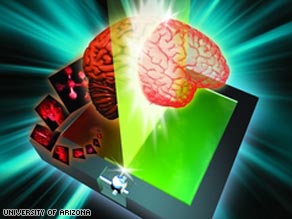
LONDON, England (CNN) -- Picture this: you're sat down for the Football World Cup final, or a long-awaited sequel to the "Sex and the City" movie and you're watching all the action unfold in 3-D on your coffee table.

The future of television? This image is an impression of what 3D holographic television may look like.
It sounds a lot like a wacky dream, but don't be surprised if within our lifetime you find yourself discarding your plasma and LCD sets in exchange for a holographic 3-D television that can put Cristiano Ronaldo in your living room or bring you face-to-face with life-sized versions of your gaming heroes.
The reason for renewed optimism in three-dimensional technology is a breakthrough in rewritable and erasable holographic systems made earlier this year by researchers at the University of Arizona.
Dr Nasser Peyghambarian, chair of photonics and lasers at the university's Optical Sciences department, told CNN that scientists have broken a barrier by making the first updatable three-dimensional displays with memory.
"This is a prerequisite for any type of moving holographic technology. The way it works presently is not suitable for 3-D images," he said.
The researchers produced displays that can be erased and rewritten in a matter of minutes.
To create television sets the images would need to be changing multiple times each second -- but Peyghambarian is very optimistic this can happen.
He said the University of Arizona team, which is now ten-strong, has been working on advancing hologram technology since 1990 -- so this is a major step forward. He believes that much of the difficulty in creating a holographic set has now been overcome.
"It took us a while to make that first breakthrough, but as soon as you have the first element of it working the rest often comes more rapidly," he said. "What we are doing now is trying to make the model better. What we showed is just one color, what we are doing now is trying to use three colors. The original display was four inches by four inches and now we're going for something at least as big as a computer screen."
There are no more great barriers to overcome now, he said.
The breakthrough has made some long-time researchers of the technology believe that it could now come to fruition.
Tung H. Jeong, a retired physics professor at Lake Forest College outside Chicago who had studied holography since the 1960s told NJ.com; "When we start talking about erasable and rewritable holograms, we are moving toward the possibility of holographic TV ... It has now been shown that physically, it's possible."
And what might these holographic televisions look like?
According to Peyghambarian, they could be constructed as a screen on the wall (like flat panel displays) that shows 3-D images, with all the image writing lasers behind the wall; or it could be like a horizontal panel on a table with holographic writing apparatus underneath.
So, if this project is realized, you really could have a football match on your coffee table, or horror-movie villains jumping out of your wall.
Peyghambarian is also optimistic that the technology could reach the market within five to ten years. He said progress towards a final product should be made much more quickly now that a rewriting method had been found.
However, it is fair to say not everyone is as positive about this prospect as Peyghambarian.
Justin Lawrence, a lecturer in Electronic Engineering at Bangor University in Wales, told CNN that small steps are being made on technology like 3-D holograms, but, he can't see it being ready for the market in the next ten years.
"It's one thing to demonstrate something in a lab but it's another thing to be able to produce it cheaply and efficiently enough to distribute it to the mass market," Lawrence said.
Yet, there are reasons to be optimistic that more resources will be channeled into developing this technology more quickly.
The Japanese Government is pushing huge financial and technical weight into the development of three-dimensional, virtual-reality television, and the country's Communications Ministry is aiming at having such technology available by 2020.
Peyghambarian said there are no major sponsors of the technology at present, but as the breakthroughs continued, he hopes that will change.
Even if no major electronics company commit themselves, there is hope that backers could come from outside of the consumer electronics industry, he said.
Wild blueberries have greater antioxidant content than common fruits such as apples, bananas, red grapes and strawberries according to Cornell University researchers.
Pomegranates, blackberries, raspberries and cranberries also performed well in the tests that measured cellular antioxidant activity (CAA) in 25 fruits. But superfruits such as noni, acai and goji did not come under the scientists’ antioxidant microscope.
In addition to CAA, the researchers also measured total phenolic content, and oxygen radical absorbance capacity (ORAC) values. These are more typical ‘in-the-fruit’ readings but the researchers wanted to test the levels of antioxidants in fruits in a more biologically representative manner, hence their application of the CAA method which measures antioxidant activity ‘in-the-cell’.
The research, published in the Journal of Agricultural and Food Chemistry, found wild blueberries notched the highest antioxidant levels under these measures also.
Melons and bananas had the lowest antioxidant activity and cultivated blueberries demonstrated less antioxidant activity than their wild cousins.
Because of the volume at which they are consumed, apples contributed most fruit phenolics to the American diet, with apples and strawberries the biggest suppliers of antioxidant activity.
Free radicals react with and attack lipids, proteins, carbohydrates, and DNA and have been linked to a number of oxidative stress conditions including some cancers.
Cellular antioxidant activity
CAA, first developed at Cornell last year, seeks to “move beyond the test tube” to determine how antioxidant compounds perform in cells – in this case human liver cells.
“The CAA assay is a more biologically relevant method than the chemistry antioxidant activity assays as it accounts for uptake, metabolism, distribution and activity of antioxidant compounds within cells versus solely looking at antioxidant value,” said lead scientist Rui Hai Liu, PhD.
Both foods and food supplements were tested.
Antioxidant activity of selected compounds is typically measured using a range of lab-based assays, including the ferric reducing ability of plasma (FRAP) assay, the oxygen radical absorbance capacity (ORAC) and Trolox equivalent antioxidant capacity (TEAC).
CAA centres on dichlorofluorescin, a probe molecule trapped within cells that can be easily oxidised to produce fluorescence. The test uses 2,2'-azobis(2-amidinopropane) dihydrochloride (ABAP)-generated peroxyl radicals to oxidise dichlorofluorescin, and the ability of antioxidant compounds to inhibit this process.
Fruits like berries are naturally high in antioxidants because of their anthocyanin content, which not only give many fruits their colour, but are high in antioxidants.
“While further testing is needed to confirm how dietary antioxidants are absorbed by and go to work in the human body to prevent cancer and other chronic diseases, we’re encouraged by the response in this initial screening measure,” Dr Liu concluded.
Related:
![]() The Council of the European Union is the principal decision making institution in the European Union (EU). It is often informally called the Council of Ministers or just the Council, the name used in the treaties; it is also called Consilium as a Latin-language compromise. Within the competencies of the Community pillar, it is the more powerful of the two legislative chambers, the other being the European Parliament. This Council should be distinguished from the European Council, which is an assembly of EU heads of state or government, and the Council of Europe, which is a non-EU organisation of 47 states. Council of the European Union |
The eruption of the global financial crisis, unprecedented since the time of the Great Depression of the 1930s, has occurred in the very heart of the capitalist system, in the center of the U.S. Empire, although its effects are extending to a shocked Europe and other regions and countries that – to a greater or lesser degree – are associates or tributaries of that empire and the world system that it heads.
In relation to Latin America, the neoliberal debacle that had as its starting point the U.S. mortgage crisis, is taking place at a particularly significant moment after a number of years – more than 10, in some cases – in which certain countries have resolutely undertaken new strategies, including social ones, and have begun to detach themselves from what President Hugo Chávez has described as "a perverse international system."
In this context, while the U.S. government is trying to inject billions of dollars with the aim of containing its financial crash, a group of Latin American nations like Brazil, Argentina, Ecuador and Chile – to quote just some – are confident that the work undertaken in their economic sectors, as well as the effective application of strategies in the social sphere, will maintain the sustained economic growth of recent years, while their international reserves have been seen to grow as never before. They have done all of that, moreover, against Washington’s dictates and the prescriptions of the financial and credit agencies under its protection.
Those nations, in one way or another distancing themselves from the disastrous neoliberal road that the powerful neighbour to the North imposed on them, not only are not only cushioning themselves but reducing to the minimum or even, escaping from the world impact generated by the shock being experienced by the U.S. system. At the same time they are demonstrating the need to continue deepening and extending the direction that they have taken on the basis of strength, independence and self-determination, thus raising themselves as an example for some less developed countries in the region and other Third World nations.
It is not by chance that what began as initiatives by Venezuela , Brazil, Bolivia or Argentina, have been taken up by the vast majority and made concrete in the Union of South American Nations (UNASUR), the Bank of the South, the Great National companies in the energy sphere and others that are currently serving as a support to member countries and others that are beginning to analyze the possibilities and convenience of a cooperative road with no political conditions or coercion, and in defense of sovereignty.
Precisely, the current session of the UN General Assembly has served for various heads of state to comment on the exceptional measures that the U.S. government – renouncing the same deregulated and neoliberal policies that it promoted and imposed on the world – is now adopting in terms of state interventionism and the rescue of the banks at the cost of U.S. taxpayers squeezed to the limit.
It has been the Latin American leaders, basically, who have made an impassioned defense of multilateralism in the international order and have warned of the consequences of continued financial speculation. The days when Washington sneezed and Latin America caught pneumonia are over.
In that context, Brazilian President Luis Inacio Lula da Silva stated that he was observing "with sadness, how very important banks which passed opinions, telling us what we should do or not do, measuring the risk to the country, advising investors whether Brazil was trustworthy or not, are going bankrupt, are calling in their creditors."
Those banks, "what they determined… was not the free circulation of capital, generating employment and wealth, but speculation… they transformed some sectors of the financial system into a casino, lost at roulette and we didn’t want Brazil to be the victim of the game," he added. The South American giant has international reserves calculated at $200 billion, which will enable it to confront the possibility of a liquidity problem. Brazil, said Lula, "has found its own way" and will continue growing.
For his part, the Bolivarian leader, Hugo Chávez, took advantage of the occasion to recall how firms like the Lehman Brothers and Merrill Lynch put out negative reports on Venezuela and now the ones crashing are "the giants. How strange that is. Now it’s the United States that cannot be invested in."
Venezuela confirmed that its hard-currency reserves are safe and that just 1% of these, which amount to more than $39 billion, is located in U.S. territory.
In similar vein Argentine President Cristina Fernández added her voice to the criticisms made by her Venezuelan counterpart against Lehman Brothers, for having predicted "calamities" for her country, when, as she said, "We are seeing how that first world once portrayed as the goal that we had to reach is bursting like a bubble."
She continued, "South America was told that the market solves everything, but now we have the strongest state intervention since the point when the U.S. told us that the state was not necessary."
In his speech to the General Assembly, Evo Morales described capitalism as "the worst enemy of humanity," while expressing his firm conviction that "one cannot have peace under capitalism."
For his part, addressing Congress with the request of $700 billion for that unprecedented rescue operation, the chairman of the US Federal Reserve warned that if financial conditions do not improve over a prolonged period, the consequences for the economy in general could be very adverse, the labor market and income are entering a slump, inflation is growing and consumption diminishing.
Without excluding the possibility of some kind of consequence for the Latin American economies, the recent meeting of the Inter-American Development Bank in Miami confirmed the current capacity of the sub-continent’s economies, in a general sense, to absorb the most disastrous consequences of the U.S. financial crisis, while making an exception of the Central American countries and Mexico, which could be the most compromised given their close economic links with the United States, including their free trade agreements.
Hurricane-sized whirlpools have been spotted spiralling on the surface of the Sun, confirming theories about how material convects in the Sun's roiling outer layers.
The scalding soup of charged particles, or plasma, in the outer 30% of the Sun is thought to rise and fall in churning cells, like macaroni bobbing in a pot of boiling water.
After the hot material rises, it releases energy and falls downwards. Because it already has some sideways motion, this cooler plasma should spiral into the Sun as it falls – like water running down a bathtub drain.
But observations over the past two decades have failed to spot these small whirlpools, which require a very high resolution to detect.
So Jose Bonet of the Instituto de Astrofísica de Canarias in Spain and colleagues went looking for the patterns using the Swedish 1-m Solar Telescope, which can observe details as small as 90 kilometres across.
The team tracked bright spots produced by moving plasma. The spots showed a swirling pattern about the size of a hurricane on Earth.
After further observation, the team found 138 of these whirlpools, each of which survived for only 5 minutes before disappearing.
Source: http://space.newscientist.com
Israel deliberately forgets its history
Every Israeli knows that he or she is the direct and exclusive descendant of a Jewish people which has existed since it received the Torah (1) in Sinai. According to this myth, the Jews escaped from Egypt and settled in the Promised Land, where they built the glorious kingdom of David and Solomon, which subsequently split into the kingdoms of Judah and Israel. They experienced two exiles: after the destruction of the first temple, in the 6th century BC, and of the second temple, in 70 AD.
Two thousand years of wandering brought the Jews to Yemen, Morocco, Spain, Germany, Poland and deep into Russia. But, the story goes, they always managed to preserve blood links between their scattered communities. Their uniqueness was never compromised.
At the end of the 19th century conditions began to favour their return to their ancient homeland. If it had not been for the Nazi genocide, millions of Jews would have fulfilled the dream of 20 centuries and repopulated Eretz Israel, the biblical land of Israel. Palestine, a virgin land, had been waiting for its original inhabitants to return and awaken it. It belonged to the Jews, rather than to an Arab minority that had no history and had arrived there by chance. The wars in which the wandering people reconquered their land were just; the violent opposition of the local population was criminal.
This interpretation of Jewish history was developed as talented, imaginative historians built on surviving fragments of Jewish and Christian religious memory to construct a continuous genealogy for the Jewish people. JudaismÕs abundant historiography encompasses many different approaches.
But none have ever questioned the basic concepts developed in the late 19th and early 20th centuries. Discoveries that might threaten this picture of a linear past were marginalised. The national imperative rejected any contradiction of or deviation from the dominant story. University departments exclusively devoted to "the history of the Jewish people", as distinct from those teaching what is known in Israel as general history, made a significant contribution to this selective vision. The debate on what constitutes Jewishness has obvious legal implications, but historians ignored it: as far as they are concerned, any descendant of the people forced into exile 2,000 years ago is a Jew.
Nor did these official investigators of the past join the controversy provoked by the "new historians" from the late 1980s. Most of the limited number of participants in this public debate were from other disciplines or non-academic circles: sociologists, orientalists, linguists, geographers, political scientists, literary academics and archaeologists developed new perspectives on the Jewish and Zionist past. Departments of Jewish history remained defensive and conservative, basing themselves on received ideas. While there have been few significant developments in national history over the past 60 years (a situation unlikely to change in the short term), the facts that have emerged face any honest historian with fundamental questions.
Founding myths shaken
Is the Bible a historical text? Writing during the early half of the 19th century, the first modern Jewish historians, such as Isaak Markus Jost (1793-1860) and Leopold Zunz (1794-1886), did not think so. They regarded the Old Testament as a theological work reflecting the beliefs of Jewish religious communities after the destruction of the first temple. It was not until the second half of the century that Heinrich Graetz (1817-91) and others developed a "national" vision of the Bible and transformed AbrahamÕs journey to Canaan, the flight from Egypt and the united kingdom of David and Solomon into an authentic national past. By constant repetition, Zionist historians have subsequently turned these Biblical "truths" into the basis of national education.
But during the 1980s an earthquake shook these founding myths. The discoveries made by the "new archaeology" discredited a great exodus in the 13th century BC. Moses could not have led the Hebrews out of Egypt into the Promised Land, for the good reason that the latter was Egyptian territory at the time. And there is no trace of either a slave revolt against the pharaonic empire or of a sudden conquest of Canaan by outsiders.Nor is there any trace or memory of the magnificent kingdom of David and Solomon. Recent discoveries point to the existence, at the time, of two small kingdoms: Israel, the more powerful, and Judah, the future Judea. The general population of Judah did not go into 6th century BC exile: only its political and intellectual elite were forced to settle in Babylon. This decisive encounter with Persian religion gave birth to Jewish monotheism.
Then there is the question of the exile of 70 AD. There has been no real research into this turning point in Jewish history, the cause of the diaspora. And for a simple reason: the Romans never exiled any nation from anywhere on the eastern seaboard of the Mediterranean. Apart from enslaved prisoners, the population of Judea continued to live on their lands, even after the destruction of the second temple. Some converted to Christianity in the 4th century, while the majority embraced Islam during the 7th century Arab conquest.
Most Zionist thinkers were aware of this: Yitzhak Ben Zvi, later president of Israel, and David Ben Gurion, its first prime minister, accepted it as late as 1929, the year of the great Palestinian revolt. Both stated on several occasions that the peasants of Palestine were the descendants of the inhabitants of ancient Judea (2).
Proselytising zeal
But if there was no exile after 70 AD, where did all the Jews who have populated the Mediterranean since antiquity come from? The smokescreen of national historiography hides an astonishing reality. From the Maccabean revolt of the mid-2nd century BC to the Bar Kokhba revolt of the 2nd century AD, Judaism was the most actively proselytising religion. The Judeo-Hellenic Hasmoneans forcibly converted the Idumeans of southern Judea and the Itureans of Galilee and incorporated them into the people of Israel. Judaism spread across the Middle East and round the Mediterranean. The 1st century AD saw the emergence in modern Kurdistan of the Jewish kingdom of Adiabene, just one of many that converted.
The writings of Flavius Josephus are not the only evidence of the proselytising zeal of the Jews. Horace, Seneca, Juvenal and Tacitus were among the Roman writers who feared it. The Mishnah and the Talmud (3) authorised conversion, even if the wise men of the Talmudic tradition expressed reservations in the face of the mounting pressure from Christianity.Although the early 4th century triumph of Christianity did not mark the end of Jewish expansion, it relegated Jewish proselytism to the margins of the Christian cultural world. During the 5th century, in modern Yemen, a vigorous Jewish kingdom emerged in Himyar, whose descendants preserved their faith through the Islamic conquest and down to the present day. Arab chronicles tell of the existence, during the 7th century, of Judaised Berber tribes; and at the end of the century the legendary Jewish queen Dihya contested the Arab advance into northwest Africa. Jewish Berbers participated in the conquest of the Iberian peninsula and helped establish the unique symbiosis between Jews and Muslims that characterised Hispano-Arabic culture.
The most significant mass conversion occurred in the 8th century, in the massive Khazar kingdom between the Black and Caspian seas. The expansion of Judaism from the Caucasus into modern Ukraine created a multiplicity of communities, many of which retreated from the 13th century Mongol invasions into eastern Europe. There, with Jews from the Slavic lands to the south and from what is now modern Germany, they formed the basis of Yiddish culture (4).
Prism of Zionism
Until about 1960 the complex origins of the Jewish people were more or less reluctantly acknowledged by Zionist historiography. But thereafter they were marginalised and finally erased from Israeli public memory. The Israeli forces who seized Jerusalem in 1967 believed themselves to be the direct descendents of the mythic kingdom of David rather than - God forbid - of Berber warriors or Khazar horsemen. The Jews claimed to constitute a specific ethnic group that had returned to Jerusalem, its capital, from 2,000 years of exile and wandering.
This monolithic, linear edifice is supposed to be supported by biology as well as history. Since the 1970s supposedly scientific research, carried out in Israel, has desperately striven to demonstrate that Jews throughout the world are closely genetically related.Research into the origins of populations now constitutes a legitimate and popular field in molecular biology and the male Y chromosome has been accorded honoured status in the frenzied search for the unique origin of the "chosen people". The problem is that this historical fantasy has come to underpin the politics of identity of the state ?of Israel. By validating an essentialist, ?ethnocentric definition of Judaism it encourages a segregation that separates Jews from non-Jews - whether Arabs, Russian immigrants or foreign workers.
Sixty years after its foundation, Israel refuses to accept that it should exist for the sake of its citizens. For almost a quarter of the population, who are not regarded as Jews, this is not their state legally. At the same time, Israel presents itself as the homeland of Jews throughout the world, even if these are no longer persecuted refugees, but the full and equal citizens of other countries.
A global ethnocracy invokes the myth of the eternal nation, reconstituted on the land of its ancestors, to justify internal discrimination against its own citizens. It will remain difficult to imagine a new Jewish history while the prism of Zionism continues to fragment everything into an ethnocentric spectrum. But Jews worldwide have always tended to form religious communities, usually by conversion; they cannot be said to share an ethnicity derived from a unique origin and displaced over 20 centuries of wandering.
The development of historiography and the evolution of modernity were consequences of the invention of the nation state, which preoccupied millions during the 19th and 20th centuries. The new millennium has seen these dreams begin to shatter.
And more and more academics are analysing, dissecting and deconstructing the great national stories, especially the myths of common origin so dear to chroniclers of the past.
Shlomo Sand is professor of history at Tel Aviv university and the author of Comment le people juif fut inventŽ (Fayard, Paris, 2008)
Source: Le Monde diplomatique
Notes:
Translated by Donald Hounam
(1) The Torah, from the Hebrew root yara (to teach) is the founding text of Judaism. It consists of the first five books of the Old Testament (the Pentateuch): Genesis, Exodus, Leviticus, Numbers and Deuteronomy.
(2) See David Ben Gurion and Yitzhak Ben Zvi, Eretz Israel in the past and present, 1918 (in Yiddish), and Jerusalem, 1980 (in Hebrew); Yitzhak Ben Zvi, Our population in the country, Executive Committee of the Union for Youth and the Jewish National Fund, Warsaw, 1929 (in Hebrew).
(3) The Mishnah, regarded as the first work of rabbinic literature, was drawn up around 200 AD. The Talmud is a synthesis of rabbinic discussions on the law, customs and history of the Jews. The Palestinian Talmud was written between the 3rd and 5th centuries; the Babylonian Talmud was compiled at the end of the 5th century.
(4) Yiddish, spoken by the Jews of eastern Europe, was a Germano-Slavic language incorporating Hebrew words.
Source: http://www.iviews.com
Consciousness traces the logarithmic spiral arcs into ever higher dimensions of being, or more precise configurations of energy, as you prefer. It is useful to visualize the spiral as a three dimensional object, a cone. As we move towards the point, each augmentation of the fractal indicates an exponentially higher level of density and complexity. More information in less space, deeper awareness in less time, all accumulating from each previous resolution. This continues as we progress through the spiral, which becomes denser as we approach its singularity point, where no further complexity or geometric enfoldment is possible. This represents a natural completion and integration stage. A dimensional shift. We are at one of these points now.
The term synchromysticism has arisen to denote the practice of locating meaningful trans-temporal resonances within diverse and apparently separate media artefacts. Film has proven itself to be one of the richest sources of study, perhaps due to its financial backing, multi-layered informational density and global audience. However, virtually any media portal can be studied including TV shows, music, literature, video games, comics, advertisements, product packaging, posters, text books, logos. Where there is dynamic information flow, there are spiral messages.
One of the most absorbing aspects of synchromystic study is the fact that many of the most profound resonators are not intentional on the part of those who manifested them. The film makers are not aware they are expressing higher dimensional resonances from the fractal spiral in their cinematic work. Instead, spontaneous 4D field uplink is just pulling it right down from the spiral and channelling it into their ostensibly ‘original’ creative work. It is feasible in this sense that nothing is created, only discovered and envisioned as one’s own construct.
Such questions of fatalism and free will melt into inconsequentiality in the face of the extreme complexity of the spiral at higher dimensional resolutions. The ability to choose from any of the trillions of paths available at every junction in every moment is as good as free will from our perspective. It’s a numbers thing. The greater the resolution, the more choices become available. The expanse of the planet is as good as infinite to a mouse. Only super advanced entities who have ascended the higher dimensional spiral architecture are able to perceive and process the vast oceans of possibilities further down the spiral. Only at such an evolutionary plateau is it viable to precisely envisage timelines, to see outcomes and choices. Even then, individual units of consciousness are prone to making unexpected decisions. As we consistently hear from channelled material, nothing is certain.
The only real preparation is spiritual preparation. Psychological and emotional balance, together with a real, deep connectedness with oneself and the natural world has never been so important. Be who you really are. Dissolve inauthentic behaviours and attitudes. Allow the universe into you. The chrysalis that we thought was the whole world, is beginning to crack open. Examine the photograph, above. The small lifeform on the left is about to leave its entire world behind. Perhaps better to stay put. But the nature of the universe is evolution. The great fractal spiral. So it emerges a different form of consciousness than before, not the same being at all. When the transformation is complete, it stretches its newly created wings in an entirely different dimension of existence.